

⚙️ Product Introduction
The Woodward SEG XU2-AC AC Voltage Relay is an electrical monitoring and protection device designed for AC voltage supervision in industrial power systems.
The XU2-AC is part of the Woodward SEG voltage relay product family. It is intended to monitor voltage conditions and provide relay switching signals when monitored electrical parameters reach configured operating thresholds.
This type of voltage monitoring equipment is suitable for industrial electrical installations, generator protection circuits, distribution systems, and control panel applications.
Its compact relay design allows integration into electrical control cabinets and protection systems. The XU2-AC model is identified by the AC voltage relay designation, making correct model verification important when replacing an existing unit.
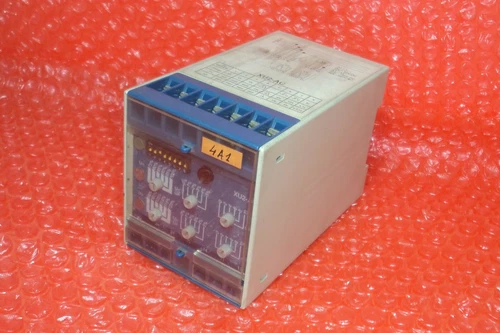
📋 Product Parameters
| Parameter | Specification |
|---|---|
| Brand | Woodward / SEG |
| Model | XU2-AC |
| Series | Professional Line |
| Product Name | AC Voltage Relay |
| Place of Origin | Germany (manufacturer origin) |
| Product Status | Industrial protection relay |
| Dimensions | Approx. 145 × 100 × 110 mm (catalog enclosure reference; verify exact installation dimensions) |
| Weight | Approx. 0.4–0.5 kg |
| Rated Voltage / Power | 100, 110, 230, 400 VAC; auxiliary supply 36–520 VAC or 50–750 VDC |
| Discontinued Status | Current production status not confirmed |
Additional Technical Specifications
-
Rated frequency: 35–78 Hz.
-
Voltage monitoring: Independent overvoltage and undervoltage supervision.
-
Voltage setting range: 75–105% Un for undervoltage; 95–125% Un for overvoltage.
-
Adjustable hysteresis: 3%, 6%, or 10%.
-
Output relays: 2 changeover relays.
-
Maximum rated current: 5 A.
-
Maximum contact voltage: 250 VAC / 220 VDC.
-
Voltage circuit consumption: 1 VA per phase at rated voltage.
-
Auxiliary power consumption: 4 W or 3 W, depending on supply connection.
-
Operating temperature: -25°C to +70°C.
-
Protection class: IP40 at the closed front cover.
-
Mounting: DIN rail installation.
Technical specifications are based on the XU2-AC technical documentation.
🔧 Daily Maintenance & Care
1. Visual Inspection: Check the relay housing, transparent front cover, terminal connections, and mounting clips for damage.
2. Electrical Inspection: Verify that the measured AC voltage and auxiliary supply remain within the specified operating ranges.
3. Terminal Maintenance: Inspect wiring terminals for looseness, oxidation, or overheating. Tighten connections according to the manufacturer’s instructions.
4. LED Status Monitoring: Observe the ON, U, and U indicators to identify abnormal voltage conditions and relay operating status.
5. Parameter Verification: Periodically inspect DIP-switch settings for rated voltage, phase sequence supervision, hysteresis, and time delay.
6. Environmental Protection: Keep the electrical cabinet clean, dry, and adequately ventilated. Avoid excessive dust, moisture, and vibration.
7. Functional Testing: Perform scheduled relay tests to verify overvoltage and undervoltage protection functions.
🛠️ Troubleshooting & Common Problems
1. Relay Does Not Power On
-
Check the auxiliary power supply.
-
Verify the voltage at terminals A1–A2 or A1–A3.
-
Inspect wiring polarity and terminal connections.
-
Check the external power protection circuit.
2. Overvoltage Alarm
-
Measure the actual phase voltage.
-
Check the configured rated voltage.
-
Inspect the overvoltage threshold setting.
-
Verify the voltage transformer and input wiring.
3. Undervoltage Alarm
-
Check the incoming AC supply.
-
Inspect the generator or distribution system.
-
Verify undervoltage settings and time delays.
-
Check for loose electrical connections.
4. Incorrect Phase Sequence Indication
-
Verify the three-phase wiring sequence.
-
Check the phase sequence supervision setting.
-
Inspect voltage sensing connections.
-
Correct the phase sequence according to the electrical design.
5. Output Relay Does Not Operate
-
Check whether the voltage threshold has been reached.
-
Verify the configured trip delay.
-
Inspect relay contacts and external control wiring.
-
Perform the manufacturer’s functional test procedure.
6. Unstable Relay Operation
-
Check for voltage fluctuations.
-
Inspect grounding and electrical interference.
-
Verify hysteresis settings.
-
Check the condition of the sensing circuit.
⚠️ Safety Precautions
-
Installation and servicing must be performed by qualified electrical technicians.
-
Disconnect all relevant power supplies before wiring or maintenance.
-
Never exceed the rated voltage and current limits.
-
Verify the correct phase sequence before commissioning.
-
Use appropriate fuses and electrical protection devices.
-
Do not modify DIP-switch settings while the system is operating unless the manufacturer’s procedure explicitly permits it.
-
Ensure the relay is correctly mounted on the DIN rail.
-
Never bypass overvoltage or undervoltage protection without an approved engineering procedure.
-
Test the protection circuit before returning the equipment to service.
🔩 Recommended Woodward / SEG Models
The following 15 models are related to voltage monitoring, generator protection, frequency supervision, and industrial electrical protection.
| No. | Model | Product Description |
|---|---|---|
| 1 | XUA1 | AC Voltage Protection Relay |
| 2 | XUF2 | Voltage and Frequency Relay |
| 3 | XU1DC | DC Voltage Relay |
| 4 | XU1E | Earth Fault Voltage Relay |
| 5 | XS2 | Current Unbalance Protection Relay |
| 6 | XRN2 | Mains Decoupling Relay |
| 7 | XRW1 | Mains Decoupling Relay |
| 8 | XRS1 | RS485 Interface Adapter |
| 9 | XR1 | Rotor Earth Fault Protection Relay |
| 10 | XE2 | Loss of Excitation Protection Relay |
| 11 | XG2 | Generator-Mains Protection Relay |
| 12 | XD1-G | Generator Differential Protection Relay |
| 13 | XP2-R | Power and Reverse Power Protection Relay |
| 14 | MRG3 | Generator Protection Device |
| 15 | MRQ1 | Field Failure Protection Relay |
Model references are from the SEG protection product family. Confirm individual specifications and compatibility before ordering.
 E-mail:dcsplcsales@gmail.com
 Wechat:+86 13365909307
 Phone:+86 13365909307